Vienna, 1902–1994
Karl Popper
Popper solved the problem of induction by denying that induction exists. Science does not confirm theories. It tries to kill them, and keeps the ones it cannot kill. Deutsch's philosophy begins here.
The view
Popper grew up in Vienna among Marxists, psychoanalysts and the philosophers of the Vienna Circle. He left Austria in 1937, spent the war in New Zealand writing The Open Society and Its Enemies, and taught at the London School of Economics from 1946.
By his own account the decisive year was 1919. Einstein's theory had just passed the eclipse test, and Popper was struck by the contrast with the theories his friends admired. Followers of Marx, Freud and Adler saw confirmations everywhere: whatever happened, the theory could account for it. Einstein had done the opposite. He had said in advance what would refute him. Popper concluded that the mark of science is not that its theories can be verified. It is that they can be falsified.
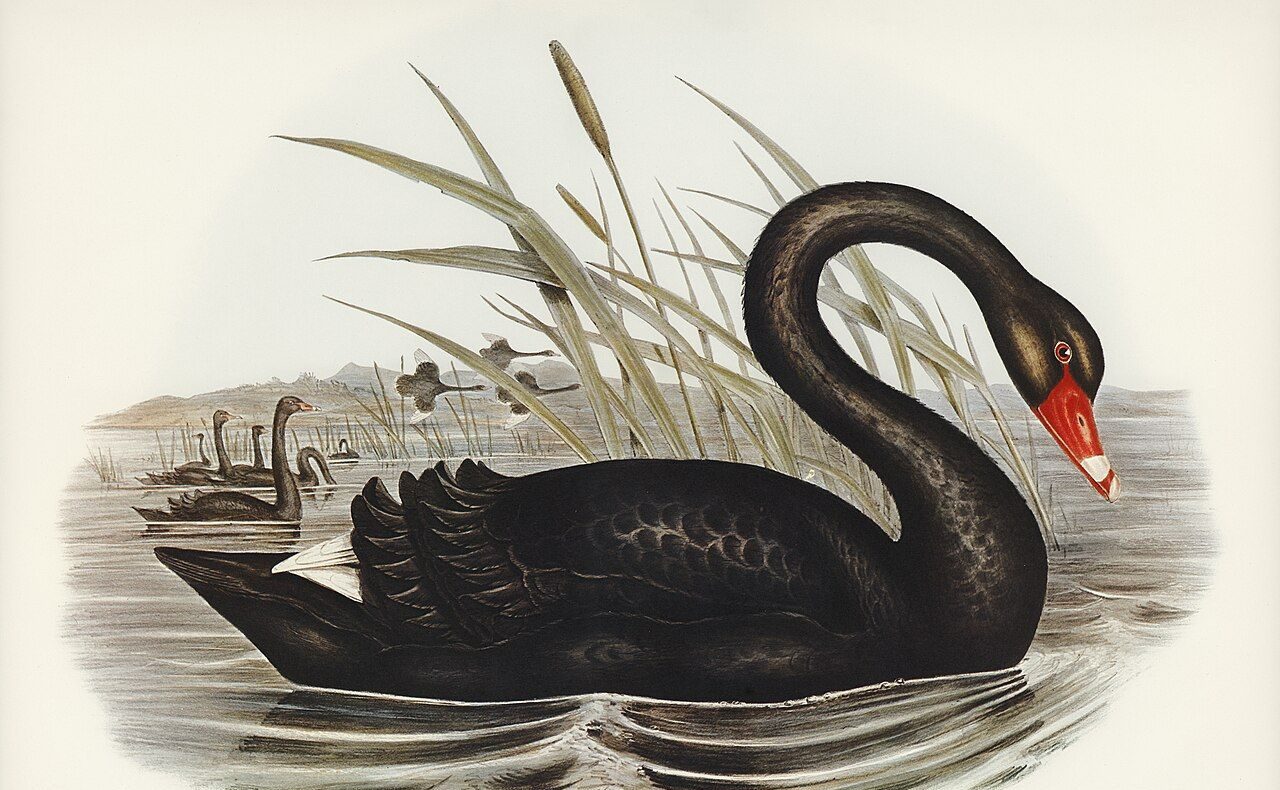
That answered an old question, how to tell science from pseudo-science, and a deeper one behind it. Hume had shown that observations cannot establish a universal law. Popper noticed an asymmetry. No number of white swans proves that all swans are white, but one black swan proves that they are not. If science proceeds by refutation, it never needs induction.
The argument
Popper's picture of inquiry is a cycle that starts and ends with problems.
We begin with a problem, propose a tentative theory, eliminate errors by criticism and testing, and arrive at a new and deeper problem. After Popper, Objective Knowledge
Several things follow. A theory is better the more it forbids, because a theory that rules out a great deal says a great deal and is easier to catch out. Bold, improbable theories are therefore the ones to want. A theory that has survived severe tests is corroborated, which is a report on its past and no guarantee of its future. And when a prediction fails, the honest response is to give the theory up, not to rescue it with an adjustment made for the purpose.
In later work Popper separated knowledge from the knower. He distinguished three "worlds": physical things, mental states, and the objective contents of thought, such as theories, arguments and problems. A proof in a library book is knowledge whether or not anyone is reading it. He also argued that the future growth of knowledge cannot be predicted, and that the course of human history therefore cannot be predicted either.
Where he meets Deutsch
Almost everywhere. Deutsch takes from Popper the whole frame of his epistemology: knowledge is conjectural; it is created, not derived; it grows by criticism; it needs no foundation and no justification; observation is theory-laden; and the tradition of criticism is the thing most worth protecting in any society. He takes knowledge without a knowing subject, and the argument from unpredictability that reappears in his account of free will. In The Fabric of Reality he names Popper's epistemology as one of the four deepest strands of explanation we possess, alongside quantum theory, the theory of computation and the theory of evolution.
Where they part
Explanation before falsifiability. For Popper the test of a scientific theory is whether it can be refuted by observation. Deutsch thinks this is necessary and not enough. A claim can be perfectly testable and still be worthless, because it explains nothing: he gives the example of a cure proposed with no account of how it could work. What makes a theory worth testing is that it is a good explanation, hard to vary while still accounting for the facts. Testability matters because it is one of the things that makes an explanation hard to vary.
Beyond science. Falsifiability marks out empirical science. Deutsch's criterion applies wherever there are explanations: in mathematics, philosophy, morality and art. It treats them all as fields where progress is possible.
The physics of knowledge. Popper's World 3 is real but abstract, and he never said what it is made of. He was also a dualist about mind and body. Deutsch gives knowledge a physical definition: information which, once embodied, tends to stay embodied. Constructor theory, developed with Chiara Marletto, aims to make that a part of physics.
Reach and optimism. Popper was a cautious optimist. Deutsch turns optimism into a principle: every problem not ruled out by the laws of nature can be solved with the right knowledge, and people are universal explainers.
| Popper | Deutsch | |
|---|---|---|
| Where does knowledge come from? | Conjecture, tested by attempts at refutation. | Conjecture: guesses, improved by criticism and experiment. |
| What does justification do? | Nothing. Theories can be corroborated by surviving tests, never justified. | Nothing. No theory is ever justified, and none needs to be. |
| Can knowledge grow without limit? | Yes. Every solution opens new problems, without end. | Yes. Problems are inevitable, and problems are soluble. |
| What is knowledge, physically? | Objective content in a "World 3" of theories and arguments: real, but not physical. | Information that, once embodied, tends to keep itself in existence. |
Further reading
- Karl Popper, The Logic of Scientific Discovery (1959; German original 1934); Conjectures and Refutations (1963), especially chapter 1; Objective Knowledge (1972), chapters 3 and 4.
- Karl Popper, Unended Quest (1976): his intellectual autobiography.
- Bryan Magee, Popper (Fontana Modern Masters, 1973): still the best short introduction.
- David Miller, Critical Rationalism: A Restatement and Defence (1994).
- Karl Popper, Stanford Encyclopedia of Philosophy.