London, 1561–1626
Francis Bacon
Lawyer, Lord Chancellor and prophet of the scientific age. Bacon held that the mind, left to itself, leaps to conclusions, and that a disciplined method of observation could do what genius had failed to do for two thousand years.
The view
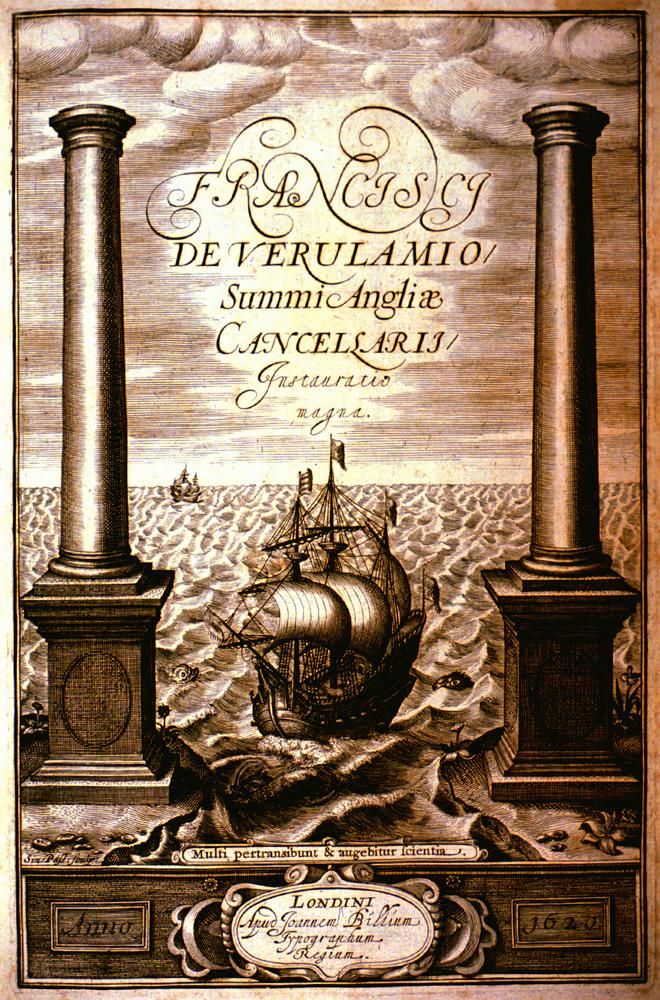
Bacon planned a complete rebuilding of human knowledge, the Great Instauration, and finished only parts of it. The most important is the Novum Organum (1620), the "new instrument" meant to replace Aristotle's logic.
Its first half is a diagnosis. The mind is no clear mirror. It is bent by four kinds of illusion that Bacon calls idols. The Idols of the Tribe belong to human nature: we see more order than there is and notice what agrees with us. The Idols of the Cave are each person's private distortions. The Idols of the Marketplace come from language, which carves the world carelessly. The Idols of the Theatre are the grand philosophical systems, which he compares to stage plays.
The cure is method. Bacon sorts earlier inquirers into two kinds. Men of experiment are like ants: they only collect and use. Reasoners are like spiders, spinning webs out of their own substance. The true philosopher is the bee, which gathers from the flowers and transforms what it gathers by a power of its own.
The argument
The old logic, Bacon says, flies from a few observations straight to the most general axioms and then deduces everything else. He calls such leaps "anticipations of nature" and wants them stopped. The right road rises gradually, from particulars to lesser axioms to middle ones, with every step checked.
The understanding must not be given wings, but hung with weights, to keep it from leaping and flying. Novum Organum I.104
The second half shows the method at work on the nature of heat. Bacon draws up three tables: cases where heat is present, cases alike in other respects where it is absent, and cases where it varies in degree. Then he excludes every candidate that fails to track heat across all three. What remains is his "first vintage": heat is a kind of motion. He hoped the procedure would make discovery almost mechanical and level the differences between one wit and another.
Where he meets Deutsch
Bacon's exclusions are refutations. He says in so many words that the negative instance carries more force than the positive, and that a single contrary case outweighs a heap of agreeing ones. He invented the phrase that became "crucial experiment". His idols are a catalogue of the ways we protect our ideas from criticism, and it has not been bettered.
He was also an optimist of exactly Deutsch's kind. Knowledge and power meet in one, he wrote; nature is commanded by being obeyed. He expected inquiry to relieve the human condition, and to do so without limit. The ship on his title page is leaving the old boundary behind.
Where they part
Bacon puts observation first and imagination under guard. Deutsch reverses both. The tables cannot be drawn up without a guess already in hand: which instances count as cases of "heat", which features to list, and which candidates to consider are all decided before the method starts. The candidate that survives, heat as motion, was a conjecture that Bacon brought to the tables, not one he found in them.
For Deutsch, the anticipations Bacon wanted to ban are the only source of new knowledge there is. The understanding needs its wings. What it needs besides is not weights but critics. And discovery cannot be made mechanical, because no procedure turns data into explanations.
| Bacon | Deutsch | |
|---|---|---|
| Where does knowledge come from? | Observation and experiment, sifted by a fixed method. | Conjecture: guesses, improved by criticism and experiment. |
| What does justification do? | Careful induction licenses each step up from particulars to laws. | Nothing. No theory is ever justified, and none needs to be. |
| Can knowledge grow without limit? | Yes. Knowledge will increase, and human power with it. | Yes. Problems are inevitable, and problems are soluble. |
| What is knowledge, physically? | No account. A true image of nature in a mind cleansed of its idols. | Information that, once embodied, tends to keep itself in existence. |
Further reading
- Francis Bacon, The New Organon, edited by Lisa Jardine and Michael Silverthorne (Cambridge, 2000). Book I, aphorisms 39–68 for the idols; 95 for the ant, spider and bee.
- Karl Popper, "On the Sources of Knowledge and of Ignorance", the introduction to Conjectures and Refutations (1963).
- Francis Bacon, Stanford Encyclopedia of Philosophy.