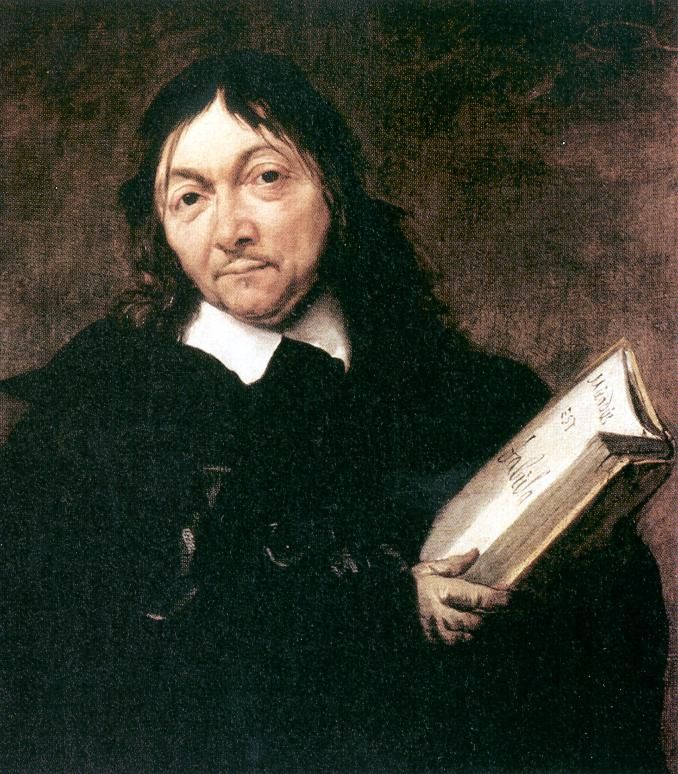
La Haye, Touraine, 1596–1650
René Descartes
Once in a lifetime, Descartes said, a serious person should tear down everything they believe and start again from the foundations. He did it in six short meditations, and philosophy has been living in the rubble ever since.
The view
Descartes was a mathematician first. He invented coordinate geometry, and he wanted all knowledge to have the certainty of a proof. The schools of his day offered a heap of opinions resting on authority. His remedy, set out in the Discourse on the Method (1637) and the Meditations on First Philosophy (1641), was to accept nothing that could be doubted and to see what was left.
What is left becomes the foundation. Everything else is to be rebuilt from it, step by step, by ideas that the mind perceives "clearly and distinctly". The model is geometry: a few self-evident starting points and long chains of simple reasoning.
The argument
The doubt comes in three waves, each wider than the last. The senses sometimes deceive, so they cannot be trusted completely. Dreams can be as vivid as waking life, so even "I am sitting by the fire" might be false. And a deceiver of great power might be feeding me every experience and even making me go wrong when I add two and three.
One thing survives. If I am being deceived, I exist to be deceived.
I am, I exist: this is necessarily true whenever I say it or conceive it in my mind. Meditations II
From there Descartes argues that he is a thinking thing, that the idea of a perfect being could only have come from such a being, that God therefore exists and is no deceiver, and that whatever is perceived clearly and distinctly must be true. The world is given back, now with a guarantee.
The return journey convinced almost no one. His friend Antoine Arnauld pointed out the circle at once: the proof of God relies on clear and distinct ideas, and clear and distinct ideas are trusted because God exists.
Where he meets Deutsch
The first half of the project is criticism without limit. Nothing is exempt: not the senses, not tradition, not the teaching of the schools. Descartes also insists that each person must do the examining for themselves and take nothing on authority. That is the spirit of the Enlightenment, and Deutsch shares it entirely.
He is right, too, that knowledge of the physical world does not come from the senses alone. In the Meditations a piece of wax melts by the fire and changes every property the senses report, yet we judge it the same wax. The judgement comes from the understanding. Deutsch would call it a theory.
Where they part
Descartes doubts in order to stop doubting. The whole exercise aims at a foundation that is immune to error, and he believes he finds one. Deutsch holds that there is no such foundation and no need for one. Knowledge is not a building that falls if the ground floor is weak. It is a set of guesses that hold each other up and are repaired piece by piece.
Popper traced a deeper fault to Descartes: the doctrine that truth is manifest, so that a careful mind cannot miss it. Clear and distinct perception plays the part for Descartes that observation plays for Bacon. Each is offered as a source that certifies what comes out of it. For Deutsch nothing certifies. Ideas that feel self-evident are wrong often enough, as the history of geometry after Descartes showed.
There is also the matter of what a mind is. Descartes makes thinking the act of an immaterial substance. For Deutsch knowledge is physical through and through: information embodied in brains, books and genes.
| Descartes | Deutsch | |
|---|---|---|
| Where does knowledge come from? | Reason. Clear and distinct ideas, some of them innate. | Conjecture: guesses, improved by criticism and experiment. |
| What does justification do? | Everything must rest on a foundation that cannot be doubted, guaranteed by God. | Nothing. No theory is ever justified, and none needs to be. |
| Can knowledge grow without limit? | As far as a finite mind can reach by deduction from the foundation. | Yes. Problems are inevitable, and problems are soluble. |
| What is knowledge, physically? | Nothing physical. Thought belongs to an immaterial mind. | Information that, once embodied, tends to keep itself in existence. |
Further reading
- René Descartes, Meditations on First Philosophy, translated by John Cottingham (Cambridge, revised edn 1996), with selections from the Objections and Replies.
- Bernard Williams, Descartes: The Project of Pure Enquiry (1978).
- Karl Popper, "On the Sources of Knowledge and of Ignorance", in Conjectures and Refutations (1963).
- Descartes' Epistemology, Stanford Encyclopedia of Philosophy.