Wrington, Somerset, 1632–1704
John Locke
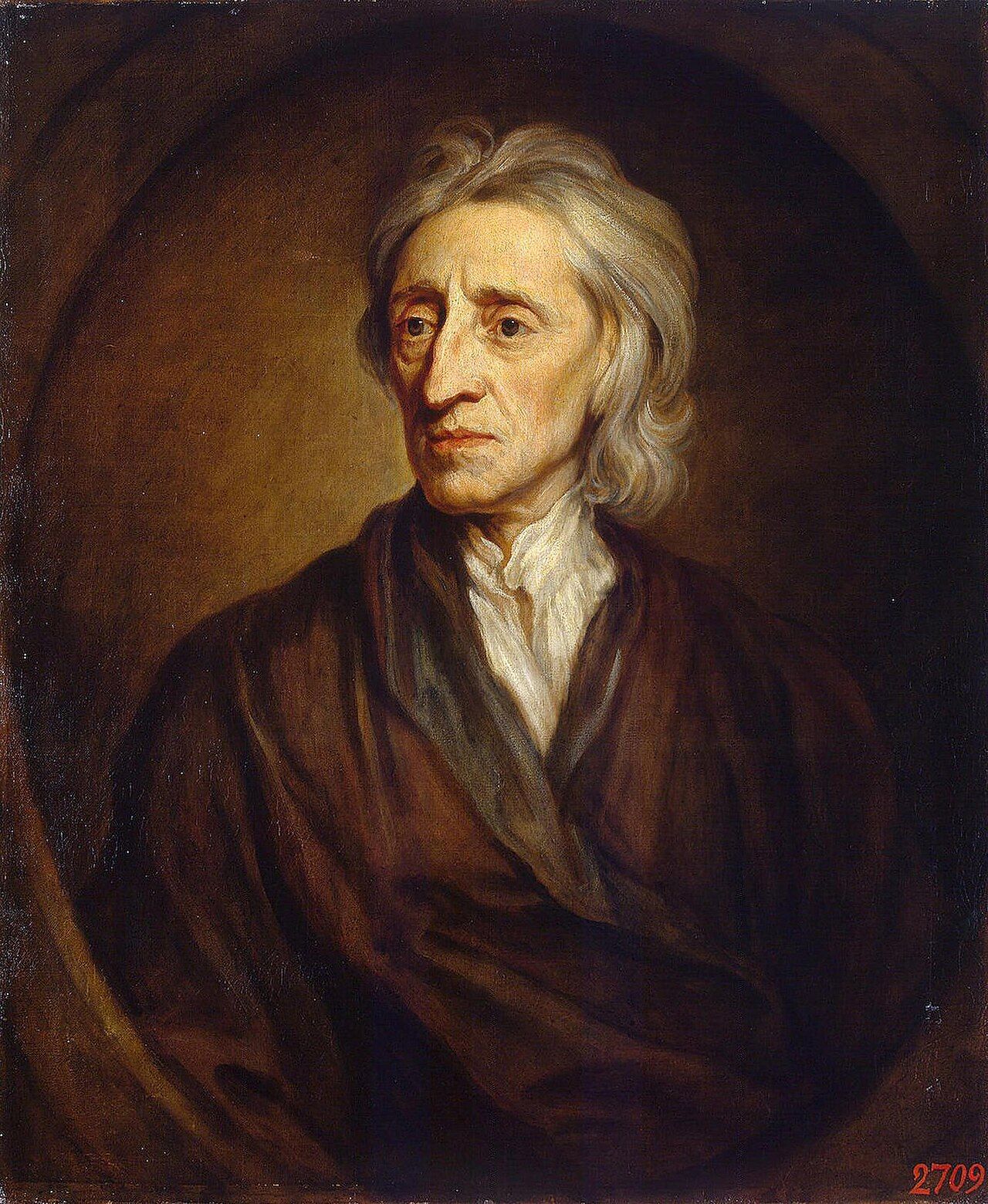
Physician, political exile and the plainest writer among the great philosophers. Locke set out to measure what the human mind can know, and concluded that everything in it has come in through experience.
The view
An Essay Concerning Human Understanding (1689) began, Locke says, with five or six friends arguing in his room and getting nowhere. He decided that before settling any question they should first ask what questions the mind is fitted to settle. He describes his own part modestly. The great builders were men like Newton; he was content to be an under-labourer, clearing away some of the rubbish that lies in the way to knowledge.
The first rubbish to go is the doctrine of innate ideas. If any principles were stamped on the mind at birth, Locke argues, children and the uneducated would know them, and they do not. So where do our ideas come from?
Let us then suppose the mind to be, as we say, white paper, void of all characters, without any ideas: How comes it to be furnished? … To this I answer, in one word, from experience. Essay II.i.2
The argument
Experience has two channels. Sensation brings in ideas from outside, such as yellow, hard and sweet. Reflection gives us ideas of what our own minds do with them: thinking, doubting, willing. These simple ideas the mind receives passively, and it cannot invent a new one any more than a blind man can imagine colour. What the mind can do is combine, compare and abstract, building complex ideas out of the simple stock.
Knowledge itself is the perception of how ideas agree or disagree. It comes in three degrees: intuition, as when we see at once that white is not black; demonstration, as in mathematics; and the sensitive knowledge that particular things exist around us. That does not reach far. For most of what matters in life God has given us, in Locke's phrase, only the twilight of probability, and a reasonable person fits the strength of each belief to its evidence.
Where he meets Deutsch
Locke's target was authority. The doctrine of innate principles, he saw, was a convenient way to put favoured opinions beyond question. Remove it and every belief has to answer for itself. His politics run on the same lines: the Letter Concerning Toleration argues that nobody has the certainty that would entitle them to force a belief on anyone else. This is the ground the Enlightenment was built on, and Deutsch stands on it.
He is also a fallibilist about nearly everything. Outside a small core, human belief is judgement under uncertainty and always open to revision.
Where they part
Karl Popper gave Locke's picture a name: the bucket theory of the mind. Experience pours in, the mind fills up, and knowledge is what settles at the bottom. Popper set against it the searchlight. What we observe depends on where we are looking, and where we look depends on a problem and a guess that we already hold. An observation that answers no question is not evidence of anything.
Deutsch accepts the searchlight and adds a second objection. The paper is not blank. A newborn arrives with expectations built in by natural selection, and those expectations are knowledge: inborn, unjustified and sometimes mistaken, but knowledge all the same. Locke was right that none of it is beyond criticism. He was wrong that none of it is there.
The limits differ too. Locke fences knowledge in: what cannot be assembled from our simple ideas, we cannot know, and the inner constitution of things is hidden from us for good. Deutsch holds that explanation reaches far past anything we could ever sense, to the inside of stars and the first seconds of the universe, because it was never built out of sensations in the first place.
| Locke | Deutsch | |
|---|---|---|
| Where does knowledge come from? | Experience alone: sensation, and reflection on the mind's own workings. | Conjecture: guesses, improved by criticism and experiment. |
| What does justification do? | Belief should be proportioned to the evidence that experience supplies. | Nothing. No theory is ever justified, and none needs to be. |
| Can knowledge grow without limit? | No. Our ideas set a narrow limit, and beyond it there is only probability. | Yes. Problems are inevitable, and problems are soluble. |
| What is knowledge, physically? | Ideas in the mind, produced by the action of bodies on the senses. | Information that, once embodied, tends to keep itself in existence. |
Further reading
- John Locke, An Essay Concerning Human Understanding, edited by P. H. Nidditch (Oxford, 1975). Book II.i for the white paper; IV.i–iii for knowledge and its extent.
- Karl Popper, "The Bucket and the Searchlight: Two Theories of Knowledge", appendix to Objective Knowledge (1972).
- John Locke, Stanford Encyclopedia of Philosophy.