United States, 1916–1996
Donald Campbell
An American psychologist who asked what a gene, a rat in a maze and a physicist have in common. His answer gave a field its name: evolutionary epistemology. Wherever knowledge increases, something is varying blindly and something is selecting.
The view
Campbell was a social psychologist and one of the leading methodologists of the social sciences. In philosophy he is known for two papers: "Blind Variation and Selective Retention in Creative Thought as in Other Knowledge Processes" (1960) and "Evolutionary Epistemology" (1974), written for a volume on the philosophy of Karl Popper.
His thesis is that Darwin's mechanism is the only known way of producing fit between a system and its environment without foresight, and that every gain in knowledge is a case of it. Three things are needed: a source of variations, a consistent process of selection, and a means of keeping and reproducing what is selected.
The word that matters is blind. Campbell does not mean that variations are random in every respect. He means that they are produced without knowledge of which will succeed. If a trial is guided towards the answer, that guidance is knowledge already possessed, and it had to be won earlier by trials that were not guided.
The argument
Campbell arranges the processes in a hierarchy. At the bottom is genetic evolution. Above it are devices that evolution has built to do the trying and failing more cheaply. A paramecium bumps, backs off and tries another direction. An animal with eyes can explore the space ahead without moving through it: vision stands in for locomotion. An animal that can think tries out actions in imagination. Language lets one person's trials serve another, and science puts the whole process on a public footing.
He calls each of these a vicarious selector: a quick, safe test that stands in for the slow, lethal test of survival. Each one is itself knowledge, earned by blind variation at the level below.
Every real gain in knowledge, and every gain in the fit between a system and its surroundings, comes from blind variation and selective retention. After Campbell, "Blind Variation and Selective Retention" (1960)
Where he meets Deutsch
On the main point they are at one. Knowledge is never poured into a system by its environment. The environment does not instruct. It only eliminates. Popper had argued this for science, and he welcomed Campbell's paper as a statement of his own view. Deutsch holds the same: the two known sources of knowledge are biological evolution and human thought, and both work by variation and selection.
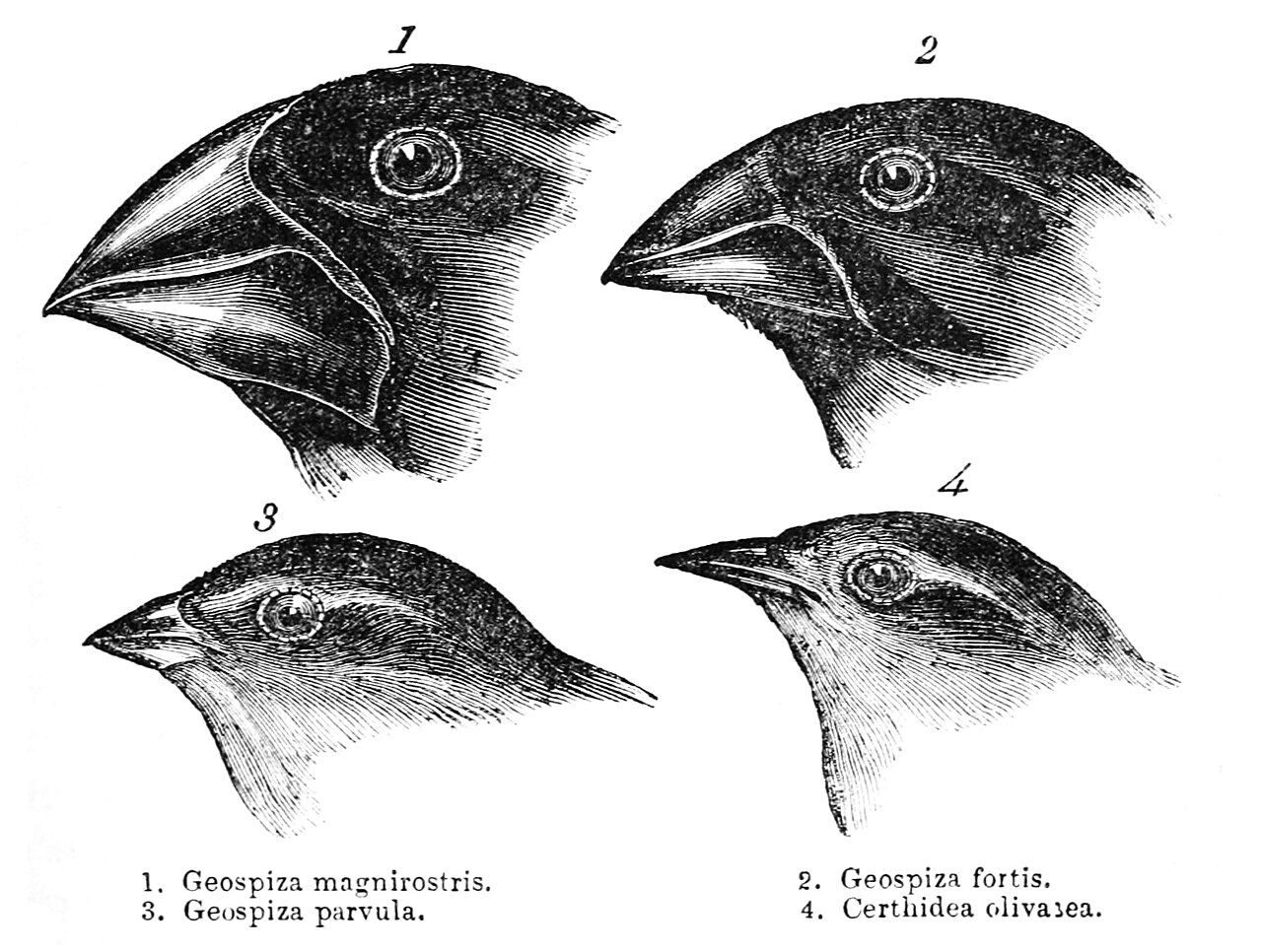
They also agree that an adaptation is knowledge in the full sense. The beak, the eye and the instinct encode facts about the world that no creature ever conceived. This is the idea that Deutsch and Marletto turn into physics.
Where they part
Campbell stresses what the two processes share. Deutsch thinks the differences matter more.
Evolution cannot look ahead and cannot cross a valley. Every step has to be viable now, so a species climbs the nearest hill and stays there. Human conjecture is not bound in that way. An idea can be worse than useless in its first form and still be pursued, because a person can see what problem it would solve. Conjectures are also aimed. They are attempts to solve a particular problem, shaped by criticism inside the mind before anything is tried in the world. Campbell would reply that the aiming is itself knowledge got by earlier blind trials. Deutsch's answer is that explanatory creativity is a new kind of process, whose workings we do not yet understand, and that calling it "blind" hides the thing most in need of explanation.
The results differ in kind as well. A beak fits one island. An explanation has reach: a theory invented to account for the motions of the planets turns out to hold in distant galaxies. Selection for local fit does not give that. Nor does Campbell's account, which describes how knowledge comes about, say what makes one piece of it better than another.
| Campbell | Deutsch | |
|---|---|---|
| Where does knowledge come from? | Blind variation and selective retention, at every level from genes to science. | Conjecture: guesses, improved by criticism and experiment. |
| What does justification do? | Nothing. What has survived selection has not been proved. | Nothing. No theory is ever justified, and none needs to be. |
| Can knowledge grow without limit? | Yes, in principle. Selection never has to stop. | Yes. Problems are inevitable, and problems are soluble. |
| What is knowledge, physically? | A fit between a system and its environment, stored in genes, brains and cultures. | Information that, once embodied, tends to keep itself in existence. |
Further reading
- Donald T. Campbell, "Evolutionary Epistemology", in P. A. Schilpp (ed.), The Philosophy of Karl Popper (Open Court, 1974).
- Gerard Radnitzky and W. W. Bartley III (eds), Evolutionary Epistemology, Rationality, and the Sociology of Knowledge (Open Court, 1987), which reprints both of Campbell's papers.
- Karl Popper, "Evolution and the Tree of Knowledge", chapter 7 of Objective Knowledge (1972).
- David Deutsch, The Beginning of Infinity (2011), chapter 4, "Creation".
- Evolutionary Epistemology, Stanford Encyclopedia of Philosophy.