Australia, contemporary
Brett Hall
Most of the people on this site are here because they disagree with Deutsch. Brett Hall is here because he explains him. His podcast, ToKCast, has spent years reading Deutsch's books aloud, a chapter at a time, and saying what each passage means.
The view
Hall studied physics, astronomy and the philosophy of science at the University of New South Wales, took a master's degree in astronomy at Swinburne University, and has worked as a science communicator and as a teacher of mathematics and physics. By his own account he came across the work of Popper and Deutsch during his first degree, and it has shaped his outlook ever since.
ToKCast, short for "theory of knowledge", began in December 2018. Its core is a long series on The Beginning of Infinity, followed by one on The Fabric of Reality and another on Chiara Marletto's The Science of Can and Can't. The method is that of a commentary. Hall reads a passage, stops, and unpacks it: what problem Deutsch is addressing, which rival view is being answered, and how the point connects to the rest of the book.
The podcast brought him into the conversation it describes. In 2021 the investor Naval Ravikant, who had found the show while rereading Deutsch, recorded a series of discussions with Hall about the book, and the two have since recorded conversations with Deutsch himself.
Hall has no rival system to set against Deutsch's. What he offers is application. He takes the theory set out on the Deutsch page and turns it on questions of the day: the use of probability in argument, forecasts of doom, and above all artificial intelligence.
The argument
His most developed argument of his own concerns superintelligence. Writers such as Nick Bostrom hold that machines will soon exceed human intelligence, that such machines might pursue goals hostile to ours, and that this is among the greatest dangers we face. Hall replies with a parable.
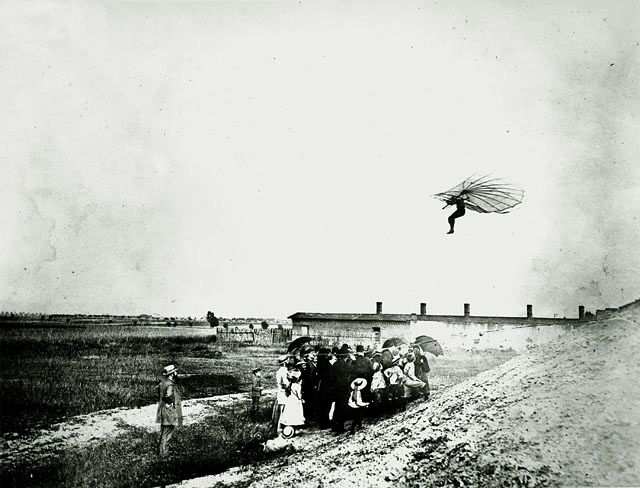
Imagine that the ancient Greeks had two schools of thought about flight. The theorists said that flight must have an explanation, and that nobody would fly until it was understood. The builders said that birds are high up, so height is the thing: build taller and taller towers, and at some height flight will simply happen. Some of the builders began to worry about what would follow when it did. After Hall, "Superintelligence", part 1
The builders' engineering may be excellent. Their mistake is their theory of flight. However tall the tower, it does not lift off, and the fears about what happens when it does are fears about nothing.
The application is direct. On Hall's reading, much of today's work on machine intelligence adds storeys: more speed, more memory, more data. If Deutsch is right about knowledge, none of that is what makes a mind. A general intelligence is a program that creates explanations, and we do not yet know how that is done. Hall does not conclude that it is impossible. He expects artificial general intelligence to be built. Following Deutsch, he concludes two things: that it will come from a philosophical advance and not from scale, and that when it comes it will be a person, a universal explainer like us, and not a superior kind of being. On Deutsch's argument there is nothing beyond universal for it to be.
Where he meets Deutsch
Everywhere, by intention. Hall presents himself as a student of these ideas, and the podcast is an act of exposition. On each of this site's four questions his answer is Deutsch's.
The parable itself restates the argument of Deutsch's essay "Creative Blocks", which is the source for section 6 of the Deutsch page. The conjecture staked there, that a system trained mainly to continue text will not originate a fundamental explanation, is the builders' tower put as a testable claim.
Exposition is also a contribution in Deutsch's own terms. Knowledge has to be embodied to last, and an idea that stays inside one difficult book is poorly embodied. Popper's ideas reached most of their readers through Bryan Magee. A good commentary does part of the work of criticism too, because explaining a passage aloud to strangers is a quick way to find the places where it is unclear.
Where they part
There is no doctrinal disagreement to report. Asked in a 2025 debate where he differs from Deutsch, Hall said he agrees with almost everything Deutsch has published, and that the best disagreement he could come up with was tea: Deutsch likes tea bags, Hall drinks only leaf. So this section records the limits of the comparison.
A commentary gives you Hall's Deutsch. Hall says so himself. In the same debate he insisted that he cannot speak for Deutsch, and described his own account as "just David Deutsch being filtered through Brett Hall". Where he fills a gap, draws a political conclusion or presses a point harder than the book does, the view is his own. Deutsch's books remain the source, and a listener who wants to know what Deutsch claims should check them. That is no criticism of Hall. It is what his own epistemology recommends: take nothing on authority, including the authority of a favourite explainer.
The second limit is the one noted on Marletto's page. Agreement among allies tests nothing. The view is tested on the pages where it meets its strongest opponents: the Bayesians, Kuhn and Quine.
| Hall | Deutsch | |
|---|---|---|
| Where does knowledge come from? | Conjecture and criticism. The same answer as Deutsch. | Conjecture: guesses, improved by criticism and experiment. |
| What does justification do? | Nothing. He treats the demand for justification as the root error of most epistemology. | Nothing. No theory is ever justified, and none needs to be. |
| Can knowledge grow without limit? | Yes. He defends Deutsch's optimism against its critics. | Yes. Problems are inevitable, and problems are soluble. |
| What is knowledge, physically? | As Deutsch and Marletto define it: information that tends to stay embodied. | Information that, once embodied, tends to keep itself in existence. |
Further reading
- bretthall.org: Hall's own site, with his essays, including the series on superintelligence, and links to every ToKCast episode.
- ToKCast, on YouTube and the usual podcast platforms. Start with the episodes on chapters 1 to 4 of The Beginning of Infinity, which cover the ground of this site.
- Naval Ravikant and Brett Hall, "The Beginning of Infinity", parts 1 and 2 (2021): a conversational introduction to the book.
- Liron Shapira and Brett Hall, "Will AGI Cooperate With Humanity?", Doom Debates (2025): Hall defends the Deutschian view of artificial intelligence against a critic. The source for the remarks about tea.
- David Deutsch, "Creative Blocks", Aeon (2012): the essay behind the argument about machines.