Athens, 469–399 BC and c. 428–348 BC
Socrates and Plato
Socrates wrote nothing and claimed to know nothing. His pupil Plato turned his questioning into the first full theory of knowledge, and gave philosophy the definition it has argued over ever since.
The view
Almost everything we know of Socrates comes from Plato's dialogues, so the two cannot be cleanly separated. The early dialogues are usually taken to show the historical Socrates; the later ones use him as a mouthpiece for Plato's own ideas.
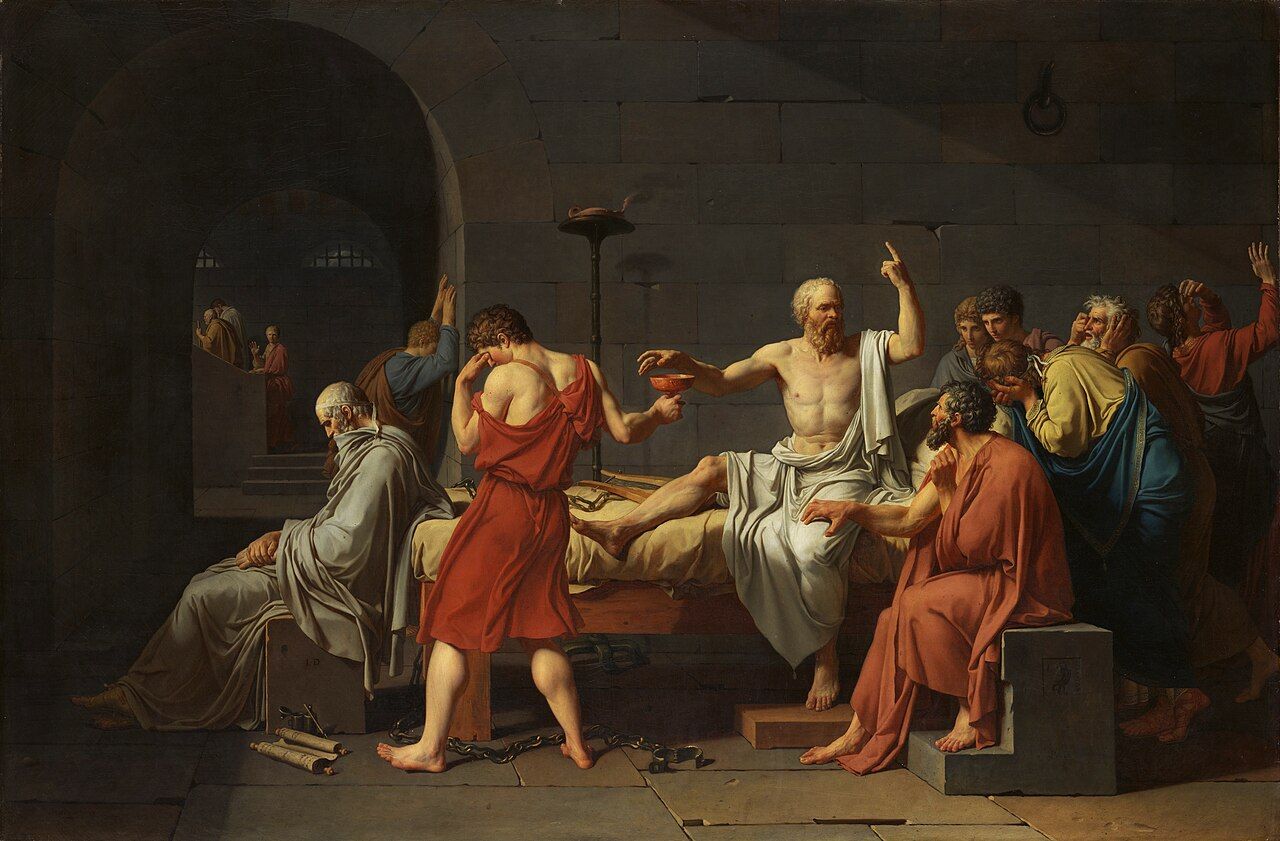
Socrates: knowing that you do not know. In the Apology, Socrates tells the court that the oracle at Delphi called him the wisest of men. Puzzled, he questioned politicians, poets and craftsmen, and found that each claimed knowledge he did not have. Socrates concluded that he was wiser only in this: he did not think he knew what he did not know. His method, the elenchus, is cross-examination. Someone offers a definition of courage or justice; Socrates draws out its consequences until it contradicts something else they believe; they try again.
Plato: learning as recollection. In the Meno, Plato faces a puzzle. How can you search for what you do not know, when you would not recognise it if you found it? His answer is that the soul already possesses the truth and learning is remembering it. To show this, Socrates leads an untaught slave to a theorem in geometry using nothing but questions.
The argument
Plato reads the scene as proof that the answer was in the boy all along. Later in the same dialogue he asks why knowledge is worth more than a true belief that happens to be right. True beliefs, he says, are like the statues of Daedalus, which run away unless they are tied down. What ties a belief down is working out the reason why it is so.
The Theaetetus tests three definitions of knowledge: perception, true judgement, and true judgement with an account. All three are refuted and the dialogue ends without an answer. Even so, the third became the standard definition for two thousand years, in the form justified true belief.
In the Republic, Plato adds that real knowledge can only be of what never changes: the Forms, grasped by the intellect. About the shifting world of the senses there is only opinion.
Where they meet Deutsch
Socrates is the first great practitioner of criticism. The elenchus creates nothing by itself; it removes error, and what survives is better than what went in. That is the engine Deutsch puts at the centre of all progress. Socratic ignorance is fallibilism too: the wise man is the one who knows his knowledge is incomplete.
Look again at the slave. He does not sit and remember. He guesses that doubling the side will double the area, sees for himself that it gives four times too much, guesses again, fails again, and only then is ready for the diagonal. Plato calls it recollection. It reads at least as well as conjecture and refutation, with Socrates supplying the criticism. Deutsch pays his own tribute in The Beginning of Infinity, which includes a dialogue in which Socrates is argued into fallibilism in a dream.
Where they part
Plato holds that knowledge is already present and has only to be uncovered. For Deutsch nothing is there in advance. The theorem about the diagonal was once a new idea that somebody had to create, and most new ideas are wrong.
Plato also wants knowledge to be tied down. The account that turns belief into knowledge is a justification, and the search for it leads to the regress that Sextus exploits and to the puzzles of Gettier. Deutsch cuts the rope: knowledge is not a kind of belief and is never justified.
Last, the Forms set a ceiling. If truth is a fixed realm seen by a trained few, inquiry can be completed, and those who have completed it should rule. Popper traced the closed society to this idea in The Open Society and Its Enemies. For Deutsch there is no final state and nobody who has reached it.
| Socrates and Plato | Deutsch | |
|---|---|---|
| Where does knowledge come from? | Recollection of what the soul already knows, drawn out by questioning. | Conjecture: guesses, improved by criticism and experiment. |
| What does justification do? | It turns true belief into knowledge, by tying it down with an account. | Nothing. No theory is ever justified, and none needs to be. |
| Can knowledge grow without limit? | Up to a ceiling. The Forms are fixed, and to know them is to be finished. | Yes. Problems are inevitable, and problems are soluble. |
| What is knowledge, physically? | Nothing physical. A state of an immaterial soul in touch with the Forms. | Information that, once embodied, tends to keep itself in existence. |
Further reading
- Plato, Apology, Meno (80d–86c for the slave and the square; 97a–98a for the statues) and Theaetetus.
- Karl Popper, The Open Society and Its Enemies, volume 1: The Spell of Plato (1945).
- David Deutsch, The Beginning of Infinity (2011), chapter 10, "A Dream of Socrates".
- Plato on Knowledge in the Theaetetus, Stanford Encyclopedia of Philosophy.