Colophon, c. 570 – c. 475 BC
Xenophanes
A wandering poet who mocked the gods of Homer and then said something stranger: that nobody has been handed the truth, that we find better things by searching, and that even when we hit on the truth we cannot know we have.
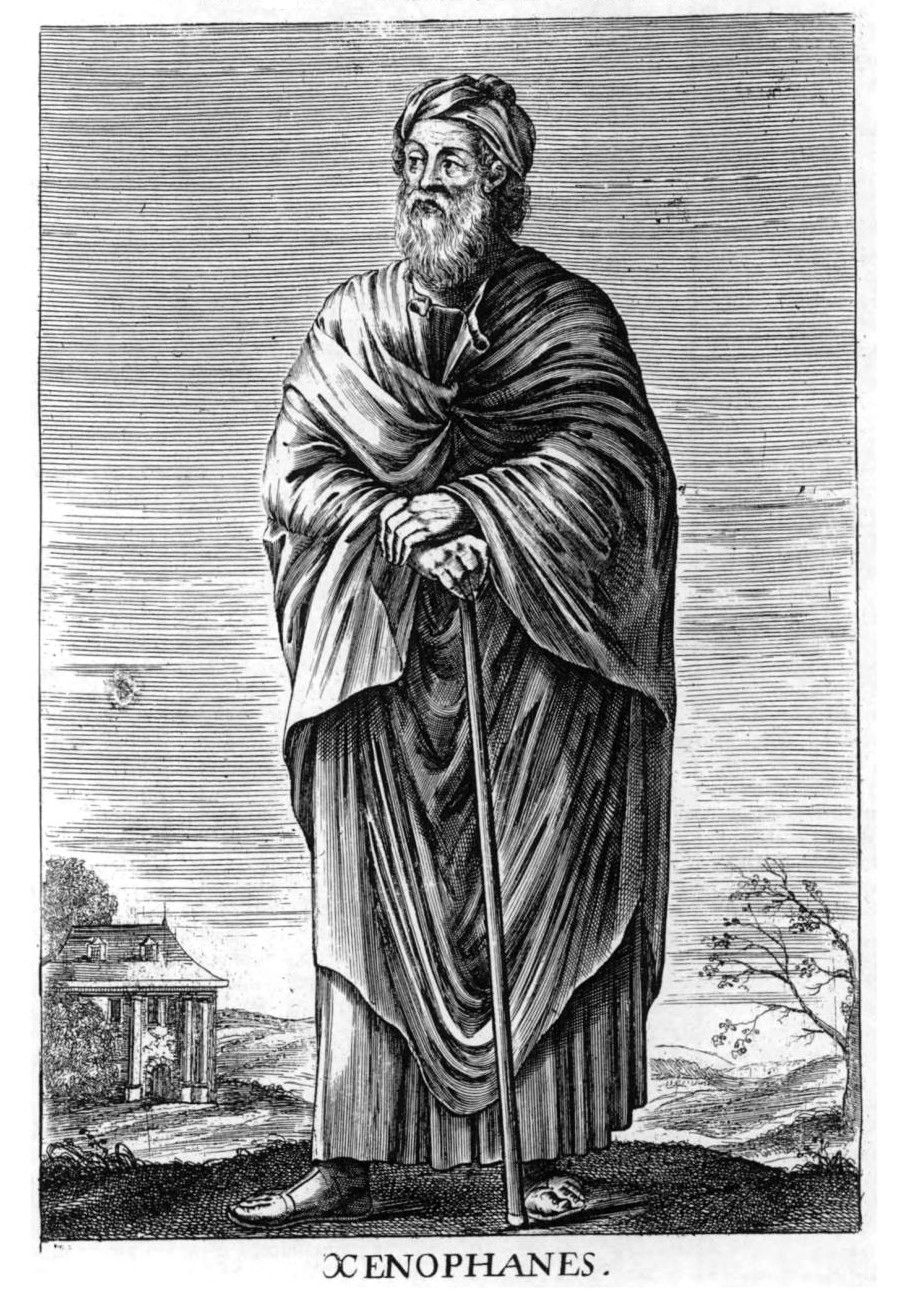
The view
Xenophanes left Colophon, on the coast of what is now Turkey, as a young man and by his own account spent most of a long life travelling the Greek world reciting his poems. Only fragments survive, quoted by later writers. They are numbered by the system of Hermann Diels and Walther Kranz, so B18 means fragment 18. The translations here are our own.
He is remembered first as a critic of religion. Homer and Hesiod, he complained, gave the gods every human vice. Worse, each people draws its gods to look like itself.
The Ethiopians say their gods are snub-nosed and black; the Thracians, that theirs are blue-eyed and red-haired. B16
If oxen, horses and lions had hands and could draw, he adds, horses would draw gods like horses and oxen gods like oxen (B15). The point reaches well beyond theology. What people take for revealed truth is their own guesswork, shaped by where they stand.
The argument
Two fragments turn that criticism into a theory of knowledge. The first denies that knowledge was ever given:
The gods did not reveal everything to mortals from the beginning; but in time, by searching, they find out better. B18
The second denies that it is ever certain:
No man has seen the clear truth, nor will any man know it, about the gods and about all the things I speak of. Even if someone happened to say exactly what is so, he himself would not know it. Opinion is spread over everything. B34
Read together they say three things. Knowledge is made by people, not delivered. It improves. And it never stops being conjecture, because hitting the truth and knowing that you have hit it are different achievements, and only the first is open to us. He asks for his own teaching to be taken the same way: as something like the truth (B35).
Where he meets Deutsch
This is fallibilism, stated twenty-five centuries before the word. Karl Popper named Xenophanes as the founder of his own tradition and translated B34 more than once. Deutsch inherits the position whole. All knowledge is conjectural; there is no authoritative source, divine or otherwise; and that is no cause for despair, because conjectures can be improved.
The pairing of B18 with B34 matters most. Many sceptics have said that we cannot be certain. Xenophanes says it in the same breath as saying that we make progress. That combination, error without end and improvement without end, is the whole of what Deutsch means by the beginning of infinity.
Where they part
There is no real disagreement to report. What separates them is what Xenophanes did not have. He offers no account of how searching finds better: no theory of criticism, no notion of a test, nothing about what makes one guess an improvement on another. He also set up one doctrine of his own, a single, unmoving god unlike mortals in body and thought, and it is not clear how firmly he held it. Deutsch's additions are the method and the measure: conjectures are improved by criticism, and the better explanation is the one that is harder to vary.
| Xenophanes | Deutsch | |
|---|---|---|
| Where does knowledge come from? | Searching and guessing. Nothing was revealed. | Conjecture: guesses, improved by criticism and experiment. |
| What does justification do? | None is to be had. Even a true statement could not be known to be true. | Nothing. No theory is ever justified, and none needs to be. |
| Can knowledge grow without limit? | Yes, in effect. By searching, people find better as time goes on. | Yes. Problems are inevitable, and problems are soluble. |
| What is knowledge, physically? | No account. | Information that, once embodied, tends to keep itself in existence. |
Further reading
- G. S. Kirk, J. E. Raven and M. Schofield, The Presocratic Philosophers, 2nd edn (Cambridge, 1983): Greek text, translation and commentary.
- J. H. Lesher, Xenophanes of Colophon: Fragments (Toronto, 1992).
- Karl Popper, "Back to the Presocratics", in Conjectures and Refutations (1963), and The World of Parmenides (1998).
- Xenophanes, Stanford Encyclopedia of Philosophy.